
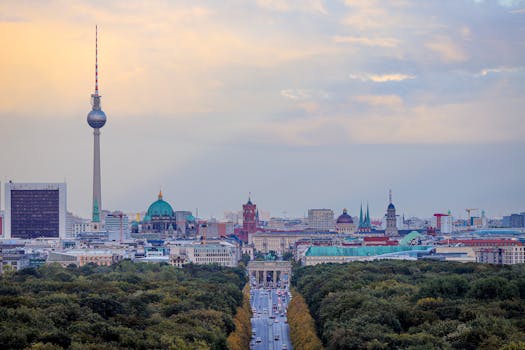

Berlin is widely regarded as the most important tango city outside of Argentina — a claim supported by a scene that offers milongas every single day of the week, year-round. With over 20 regular weekly milongas, dozens of dance schools, and a community that draws tango enthusiasts from across Europe, the German capital rivals Buenos Aires in sheer variety.
History
Tango first arrived in Berlin during the early 1900s as part of the European tango craze that swept from Paris through London and the German capital. But Argentine tango as we know it today took root in Berlin in 1982, when the Horizonte Festival der Weltkulturen at the Berlin Philharmonie featured Astor Piazzolla and other Tango Nuevo artists. That same year, Argentine emigrant Juan D. Lange opened the Tango-Bar at the Metropol-Theater and went on to found the Estudio Sudamerica dance school in 1985, becoming the scene's acknowledged pioneer. The fall of the Berlin Wall in 1989 opened up vast, affordable spaces in the eastern districts — former ballrooms, factory halls, and cultural centers — that gave the tango community room to grow. By the 2000s Berlin had established itself as Europe's undisputed tango capital.
The Scene
Berlin's tango scene is famously diverse and relaxed. Traditional milongas coexist comfortably with neo-tango, queer tango, and fusion events — sometimes in the same venue on different nights. Close embrace is the norm at traditional milongas, but open embrace and tango nuevo are widely accepted elsewhere. The cabeceo is generally preferred for invitations, but a verbal invitation is perfectly acceptable at most events. Dress code is casual by international standards; jeans and a nice top are fine at most milongas, though a few events like Tango Rouge at the KitKatClub enforce a strict dress code. One honest note for visitors: Berliners can take a few visits to warm up to newcomers — the community is tight-knit. Don't take it personally, come back a second and third time, and the dances will come.
Practical Information
Venues & Neighborhoods
The tango geography of Berlin follows its polycentric structure, with three main clusters. The densest hub is Kreuzberg-Neukoelln, anchored by Tangoloft on Pfuelstrasse near Schlesisches Tor (hosting milongas almost every night), Oblomov on Lenaustrasse, and Villa Kreuzberg on Kreuzbergstrasse — all reachable within a 15-minute walk. The second cluster runs through Mitte, from the historic Claerchens Ballhaus on Auguststrasse (a stunning 19th-century dance hall hosting Wednesday milongas in its mirror room) to Nou Tango on Chausseestrasse and the legendary Roter Salon at the Volksbuehne — one of the oldest milongas in Berlin. The third hub centers on Schoeneberg, where Mala Junta on Kolonnenstrasse offers milongas and classes in a fourth-floor studio three courtyards deep.
Annual Highlights
Embrace Festival
Berlin's largest annual tango festival. A full week of workshops, milongas, and performances drawing international teachers and dancers.
Open-Air Season
Strandbar Monbijou hosts tango nights by the Spree. Pfefferberg Glaspalast runs open-air Sunday milongas. The dance floor quality is debatable, but the atmosphere is unforgettable.
International QueerTango Festival
Multi-day festival celebrating queer tango culture. Berlin's queer tango scene is one of the most established in the world.
High Noon Tango Marathon
Intimate marathon format with multiple DJs, brunches included, and a loyal following. Registration required.
Milonga Cristal & Subte
Monthly themed Saturday milongas at TTMS in Kreuzberg. Cristal has tombola and social hero shows; Subte is smaller with homemade snacks.
Venues in Berlin
You Should Be Dancing...! Dance Center
Berlin, Germany
Ballhaus Wedding
Berlin, Germany
weRK36
Berlin, Germany
Renovated Hotel
Berlin, Germany
La Berlinesa
Berlin, Germany
Tangotanzen Mach SchöN
Berlin, Germany
Rixdorf
Berlin, Germany
DAZ (The German Architecture Center)
Berlin, Germany
Bebop
Berlin, Germany
Klosterstraße 44, 10179 Berlin
Berlin, Germany
Jungen Tanzhaus Berlin
Berlin, Germany
TBA (Hotel Aquino)
Berlin, Germany
Alter Roter Löwe Rein
Berlin, Germany
Events in Berlin
See all 21 →
Tango Café - La Bruja
Apr 11, 2026 · Berlin, Germany

Tango GYM - The Sunday Class
Apr 12, 2026 · Berlin, Germany

Tango - The Ballhaus Milonga
Apr 15, 2026 · Berlin, Germany

Three-Day TANGO Orchestra
Apr 17-19, 2026 · Berlin, Germany

Milonga La Remise
Apr 18, 2026 · Berlin, Germany

Milonga Tango zum Glück
Apr 19, 2026 · Berlin, Germany
Milonga Tango zum Glück
Apr 19, 2026 · Berlin, Germany

Milonga Mimosa - Sundays at Mala Junta
Apr 26, 2026 · Berlin, Germany

Tango - The Ballhaus Milonga
Apr 29, 2026 · Berlin, Germany
Insider Tips
- ✨Cafe Dominguez on Sunday afternoons at Nou Tango is a local favorite — small, packed, great music, serious dancers. It rewards persistence.
- ✨Roter Salon at the Volksbuehne is one of Berlin's oldest milongas with a unique red-velvet theater setting. It doesn't run every week — check milongas-berlin.de for dates.
- ✨Many milongas offer a free beginner class 30-60 minutes before the social starts. Milonga Popular on Mondays is known for classes that are an event in themselves.
- ✨For real-time info on tonight's milongas, check milongas-berlin.de (map + daily listings) or the Facebook group 'Where do you dance tango tonight in Berlin?'
- ✨Tango Rouge at the KitKatClub basement is Berlin's most unusual milonga — strict dress code, atmospheric venue. Not for the faint-hearted, but uniquely Berlin.
Where to Stay
For the best tango access, stay in Kreuzberg (near Schlesisches Tor or Mehringdamm) — you'll be walking distance to Tangoloft, Villa Kreuzberg, and several other venues. Mitte works well too, especially near Oranienburger Tor or Naturkundemuseum. Budget hostels start around 20-30 EUR/night, a private Airbnb in Kreuzberg or Neukoelln runs 50-80 EUR. During the Embrace Festival in May, book at least 6-8 weeks in advance.
Compared to Other Cities
Berlin's tango scene dwarfs every other German city. Hamburg and Munich each have active communities, but Berlin offers three to four times the variety. What sets Berlin apart is not just quantity but diversity — the spectrum from strictly traditional to radically experimental exists nowhere else in Europe. The trade-off is that Berlin's relaxed attitude extends to floor craft, which can be uneven at mixed-music milongas.
FAQ: Events in Berlin
How many events are there in Berlin?
How much do events cost in Berlin?
How do I get to events in Berlin?
What language are events in Berlin held in?
What is the best time to visit Berlin for events?
This information is community-sourced and provided without warranty. If this is about you or your organization, or if you notice an error, please let us know.